
Understanding and Supporting Early Literacy to Give Every Michigan Child a Superpower
(April 20, 2026) – By: Stephen Wallace, Regional Engagement and Mobilization Associate, and Maddie Elliott, Early Childhood Policy and Program Associate
“Literacy is an ordinary superpower that every child deserves.” – Governor Gretchen Whitmer
As a child, I remember losing myself in the fantasy worlds of different books and imagining how cool it would be to live those lives; sometimes it seemed like I could transport myself through the pages and experience events in real time. This is the ordinary superpower that Governor Whitmer was talking about and that every child deserves. Reading is the single most important skill a child can learn. Poor literacy skills make it difficult to learn math, understand science, or discover the marvels of history. Reading is also one of the most affordable hobbies a person can have, makes the world more accessible and grows imagination. Literacy is vital for education and so much more, and we must invest in early literacy so that every child can enjoy this superpower for the rest of their lives.
So how do we give each child this power? We need increased investments in education and we need to use the best, evidence-backed teaching methods, such as the Science of Reading (which we will talk more about later). But there are also important literacy elements that happen outside child care/school environments. What can parents/caregivers and others do before children even reach school to make sure they are ready?
Reading, Singing, and Talking
It might seem simple, but we need to read, talk, and sing to our children. Small children are sponges that soak up and retain information. Hearing more words is a key early literacy advantage. According to Health Partners, babies from birth to their first birthday begin to recognize important sounds in their environment. Reading, singing, and talking to them begins to develop their vocabulary, communication skills, and helps them to associate emotions with words.1
Kids who are read to in infancy have higher language skills and improved literacy over those who don’t get this early reading.2 And, bonus, babies initiated into reading aloud, also have a higher interest in reading as they get older! Kids who are read just one book a day by age five have heard 290,000 more words than kids who aren’t being read to regularly by a parent or a caregiver. If a child is read to five times a day, they enter kindergarten hearing 1.4 million more words than kids who were never read to.3 Being familiar with more words makes it easier to learn to read when they see the words in print at school.
Reading five books might be a lot, but talking to babies and toddlers as if you were having a conversation with them or singing counts, too. Even really bad, embarrassing made-up songs with real words count! If we wait for pre-k teachers and kindergarten teachers to be our children’s introduction to reading, our kids are already behind.
Adult Cell Phone Usage
As my grandma would say “it’s them phones.” While older folks like to blame a lot of the younger generation’s struggles or errant behaviors on cell phone usage there is some validity to this claim. Since the advent of smartphones and social media we are all spending more time on our phones (even my grandma) and it’s impacting the amount of face-to-face interactions we are having with children. Some researchers call adult cell phone use “technoference,” because it disrupts essential parent-child interactions. This leads to reduced language development, increased child behavioral issues, and reduced emotional connection. High parental phone use, particularly social media use, is associated with 29% less talking to children; it replaces quality interaction with passive presence.4
Social Media Impacts Early Childhood Reading
Children mirror the behavior of the trusted adults around them. If they have parents or caregivers with high phone usage, then they are likely to experience increased screen time. According to Child and Screen recommendations, children under the age of two should avoid screen time unless they are video chatting with family. Unfortunately, according to a study by Common Sense Media, the current generation of kids under the age of two are on screens for more than an hour a day. Not only does screen time reduce words heard per day, which we know is important for early literacy, but it also harms the development of social skills and other cognitive development.56 Research is pretty clear that kids under two do not understand what they see/hear on screens unless an adult helps them understand it; they may be distracted by movement, colors and sounds – but under age two, kids are not learning when viewing screens on their own.
This data and stance is supported by multiple studies and they all reach the same conclusion, increased screen time is harming children’s ability to learn how to read and socially interact before they even reach kindergarten. While technology has its positives, like being able to foster a relationship with a faraway grandparent, it can never replace face-to-face interaction. Screens are convenient to busy parents, but as children’s brains develop we must remember that one day they will be in a classroom with other children and then eventually be adults; we need to limit the screen time and increase the words and social interactions to best prepare them for reading and life.
Volunteering and Mentoring
The state of Michigan is currently ranked 44th in the nation for 4th grade literacy, and since there are only 50 states – well, that’s really bad. Improving early literacy skills is a key part to kids learning to read once they get to school. Raising Michigan’s literacy scores is not just up to parents, caregivers and teachers; we need folks to volunteer to read at schools and libraries.
I still remember when Drew Neitzel read to my second grade class at West Elementary in Wyoming, MI. Drew played at the local high school and would go on to be Mr. Basketball in Michigan and play at Michigan State University. It made such an impression that it’s still one of my strongest early reading memories. Now my first grade son is having a similar experience at his school; the Detroit Red Wings read a book to his class every Friday. The other night he asked if we could watch hockey for the first time because ‘his readers’ were going to be on television. These volunteers helped open up a new interest for my son, and I hope they – and you, reader – realize how important such simple acts can be to early literacy
Investing in Early Literacy
Michigan has made some meaningful investments in early literacy; the Great Start Readiness Program (GSRP), a free preschool program for Michigan 4 year-olds is one example. But sustained commitment will be critical to long-term success in early literacy (0 through 4). GSRP is funded at $626.5 million for 2026, with a proposed increase to $764.7 million in 2027 to make the program available to all Michigan 4-year-olds. According to the National Institute of Child Health and Human Development, high quality early education builds literacy, numeracy, social, and behavioral skills that support lifelong learning.7
The Governor also proposed a $50 million investment over 5 years for LETRS PreK-5 teacher training, which is strongly evidence-based and centered in the science of reading. Finally, the Governor proposed a $10.5 million increase in funding for Early Literacy Teacher Coaches who assist teachers in developing and implementing instructional strategies for pupils in grades pre-K to 5. This would bring funding to $52.5 million, and would support 420 coaches across the state; or one additional coach per ISD over FY 26 levels.
There is an additional investment that Michigan needs to make in early literacy. Children who have developmental delays and disabilities deserve access to high-quality early intervention (EI) services that support their literacy skills and overall development. This is what Michigan’s Early On program provides to children from birth to age three, but limited state funding constrains the program’s impact.
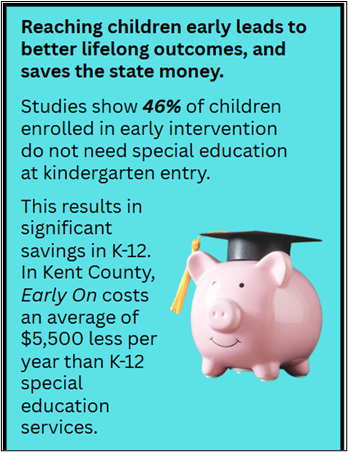 The result of underfunding Early On is staggering: every year, Michigan misses roughly 32,000 young children with disabilities and developmental delays who go on to need more expensive special education services in K-12. It would benefit children and save our state money to increase investment in less costly Early On services, rather than paying more for interventions once a child has fallen farther behind.
Michigan’s Children and the Early On Coalition have asked state lawmakers for an additional $5 million for Early On in this year’s budget, to bring state School Aid funding to $28.7 million. To be clear this is still far below what experts estimate Michigan needs to develop a strong early intervention system – but it’s better than the flat funding that was proposed in the Governor’s budget. Michigan families are clamoring for Early On services – referrals have risen 35% since 2019.
We need your help to get this funding increase across the finish line! Take a stand for early literacy today using our easy Early On call script and action alert:
- Early On call script
- Early On action alert
- Early On funding request – This short PDF helps educate lawmakers and their staffers about Early On, and provides strong arguments for our funding request. Consider reviewing this PDF for extra talking points, and/or emailing it to your state lawmakers!
Michigan has to sustain investments in early literacy to give every Michigan kid a much stronger start in their literacy journey. Early literacy programs need funding, and be paired with accountability, and community engagement to ensure that every child in Michigan can be a reading superhero.
- https://www.healthpartners.com/blog/kids-developing-communication-skills/
- https://publications.aap.org/pediatrics/article/154/6/e2024069090/199467/Literacy-Promotion-An-Essential-Component-of
- https://journals.lww.com/jrnldbp/Abstract/publishahead/When_Children_Are_Not_Read_to_at_Home__The_Million.99226.aspx
- https://pmc.ncbi.nlm.nih.gov/articles/PMC10353947/#:~:text=As%20screen%20time%20reduces%20the,one’s%20psychological%20health%20in%20general
- https://www.commonsensemedia.org/sites/default/files/research/report/2025-common-sense-census-web-2.pdf
- https://www.childrenandscreens.org/wp-content/uploads/2025/10/Guide-For-Early-Child-Development-and-Media-Use-Infants-and-Children-Ages-0-5.pdf
- https://www.nichd.nih.gov/health/topics/factsheets/early-learning